Friday, July 29, 2011

Yard Makeover: Day 3

And we so continue with our yard makeover project of the week.  On Day 3 Team Turf installed sod in the front yard, continued to pull out unwanted shrubs and dangling limbs, and finished the day by adding fresh pinestraw, and cleaning up the mess we made in the progress!


So here is the original before photo . . .


And here is the newly landscaped front yard . . .


Wow!  What a difference a landscape can make!  Not only will the homeowners now be able to add new plantings in the pine areas down the road, but their home is no longer hidden behind overgrown junipers.  And curb appeal?  They've definitely got it now.  Take a look --


On Day 4 the backyard gets its makeover, so make sure you check back to see the final results!

Wednesday, July 27, 2011

Yard Makeover: Day 2

We've been so busy with this week's yard makeover that I just realized I forgot to update you all on the progress we made yesterday.

If you remember, we were removing an outdated railroad tie retaining wall (that was actually hidden beneath a mound of junipers -- yikes)!  and replacing it with very natural-looking stacked stone, installing new sod, and in general, just tidying up the aesthetics of the yard.

So here's what we started with on Monday . . .


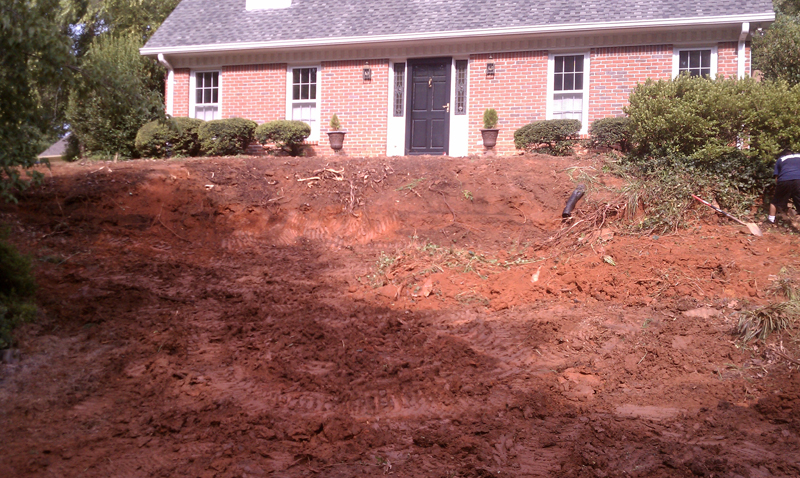
And this is what the front yard looked like at the end of the day yesterday . . . 


The junipers were completely pulled out and disposed of, as was the hidden retaining wall underneath.  Grading was done to accommodate the new retaining walls, and we also pruned existing bushes that will remain in the new landscape.


We're so excited to have you all follow along on this yard makeover, and I hope that you'll see how easy it is to give your landscape an entirely new look!  What I especially love about the changes taking place at this property is that in the end you'll really be able to see the house -- it won't be hidden behind a mound of plants and foundation bushes.

Also, this is a good example of how you don't have to do everything at once.  The beauty of re-landscaping is that you can bite off chunks at a time.  The Roaches are doing a major overhaul with the new retaining walls and sod, but they will also be waiting until the fall to install fresh plantings that will complement their new landscape.

So, that was day two, and currently day three is underway.  The sod is being installed, and even more clean-up is taking place.  Stay tuned . . . 

Monday, July 25, 2011

What Team Turf Is Up to This Week

So, we're trying to get better about showing you all exactly what we spend our time doing other than making rounds at our regular maintenance accounts.  Our install crews have been extremely busy this summer enhancing the outdoor living spaces of several of our existing clients, as well as new clients that sought us out for specific projects.


This week we're at the home of Al and Betsy Roach where we're planning an extreme yard makeover.  The homeowners have gone through multiple yard environments over the years as they slowly lost three very large oak trees that were original to the property when the home was built.  The loss of the trees dramatically changed the landscape until they were left with a mass of junipers, a failing railroad tie retaining wall beneath the junipers, and no real focal point in the yard.


Once the project is complete, the junipers will no longer be present, nor will the rotten and outdated railroad ties.  Instead the front yard will boast a stacked stone retaining wall, completely new sod, and several areas for new plantings.


Take a look at what the front yard looked like before we began this morning:


We're very excited to be a part of this yard transformation, and we hope you'll check back to see the finished result.  What you'll find is that a good clean-up, the addition of a more modern hardscape created from resilient materials can really pack a punch!

Thursday, May 5, 2011

Spruce Up Your Yard Without Breaking the Bank

So many times I hear, "We'd love to make our yard look better, but it's just not in the budget this year."  I imagine for some folks updating their landscape is never really in the budget, just like when you hear someone say that they're not financially ready to have children.  Those of us with kids know that you're never really ready financially!  And granted, a complete yard overhaul can get costly, but there are some simple ways to improve outdoor living areas that aren't so hard on your wallet.

One of the easiest ways to achieve a quick yard makeover is to do a clean-up.  Many properties that we see have tons of bedded areas, and gathering and removing branches and pine cones, raking out dead leaves, and freshening the straw or mulch in those areas packs an immediate punch.  We also suggest removing aged, overgrown shrubs.  Less is definitely more in this instance -- bare and clean is much crisper and pleasing to the eye than overgrown and wild.  This is supposed to be your yard after all, not a jungle!

And, of course, mowing, edging, and simple, regular maintenance will help your yard look tended and loved. Adding some color in flower beds or bright colored pots will also distract the eye from other the other stuff and take care of bumping up your curb appeal at the same time.

So those are just a few of the simple ways to vamp up your landscape a bit, but if you've got bigger plans in mind, then we'd love to talk about those, too.  Retaining walls, paver patios, outdoor fireplaces . . . these are a few of our favorite things!  Whatever your plans for your yard this season, Team Turf is happy to help you make those a reality.

Monday, March 14, 2011

March Is the Time To . . .

  • Prune hollies, boxwoods, gardenias, spireas, abelias, butterfly bushes, evergreen shrubs, and most summer-blooming shrubs.  
  • Cut back and fertilize roses (although you can do this as early as Valentine's Day).  Cut hybrid teas back to 18" tall, remove dead canes, and canes that rub. Knockout roses can be pruned back to half their size if necessary. Climbers should be pruned after first flush of blooms.
  • Fertilize shrubs, trees, and Fescue lawns.
  • Fertilize blueberries with Cotton Seed Meal.
  • Get those vegetable seeds started so you can set them out in mid to late April.
  • Cut back ornamental grasses to 6-10 inches tall.  If they were laying over on you last year, it may be time to divide them as most grasses will need dividing every 4-6 years.
  • Clean any debris from fountains and ponds, check hoses for cracks, scrub clean with a mild solution of bleach.
Want some help?  Give us a call because we'd love the chance to help get your yard ready for Spring!

Friday, February 4, 2011

It's Time to Prune

This is the time of year that you will look outside and see our crews pruning and cutting back the perennials in your yard.  So don't get upset when you come home and things look tidier, and perhaps a bit smaller -- we're doing what needs to be done to get your yard ready for spring. 

Here is a quick overview of why we do what we do:


Why prune?   
  • Reduce plant size,
  • Reshape plant
  • Remove dead, damaged, diseased wood
  • Encourage new growth and more bloom
When?
  • If it blooms in spring, prune soon after it finishes blooming - these plants bloom on last year's growth. 
  • If it blooms in summer or fall, prune in late winter to early spring - these plants bloom on current year growth.
  • Dead and diseased wood can be removed anytime.
How?             
  • Use sharp tools, with the cutting edge toward the part that stays on the plant.
  • Cut about ¼" above an upward- or outward-facing bud, at a 45˚ angle,
OR
  • cut back to a main branch or trunk, not flush, but just to the slightly raised branch collar.

Pruning the plants in your yard is just one more thing that Team Turf does to keep your yard looking its very best.  If you have any questions about specific plant pruning, please feel free to give us a call.

Wednesday, August 18, 2010

Conditions Are Right for Fall Armyworms

A lot of yards have suffered this summer.  Scorching temperatures, not enough rain, too much rain -- all of these factors have worked together to upset the very delicate balance that nature strives for in order to keep our grasses green and our flowers and plants thriving.  One would think that with Fall creeping ever closer that we'd be in for a bit of reprieve with the promise of cooler temps and the ability of our yards to heal themselves, so to speak.

Enter the Fall Armyworm.  Who, you ask?  Well, apparently these little pests have been becoming more and more active within the United States over the past few years, and their ability to take a thriving, healthy lawn and swiftly and efficiently make it the most unsightly yard in the neighborhood has gained them much notoriety.

Here are some things you should know:
  • The fall armyworm (Spodoptera frugipeda) are caterpillars that feed on agricultural and turf grasses.
  • The larvae feed at night on grass blades while the caterpillars feed on a variety of plants.
  • Warm-season grasses such as bermuda grass, St. Augustine grass, and some others are commonly attacked.
  • Bluegrass, ryegrass, fine fescue, and bentgrass are preferred cool-season turfgrasses.
  • Heavy infestations may seriously damage large areas of turf.
  • Populations of fall armyworms are typically kept in check by natural means, though population booms can occur, generally after a drought.
  • The damage creates a frosted appearance or a brown area (look for this symptom late in the summer or early fall) or in the case of severe infestation, the turf may be completely denuded.
Below is a photo of an adult armyworm.

And this is a photo of a young armyworm.

Heavy infestations of armyworms can seriously damage large areas of turf, so let's hope that we don't run into any of these little critters in our yards.  If you do suspect that some type of pest has taken up residence in your lawn, be sure to look for dew sparkling on the webs in the early morning or at dusk -- a sure sign of armyworms.  Treatment is definitely possible, but catching on early is the key.